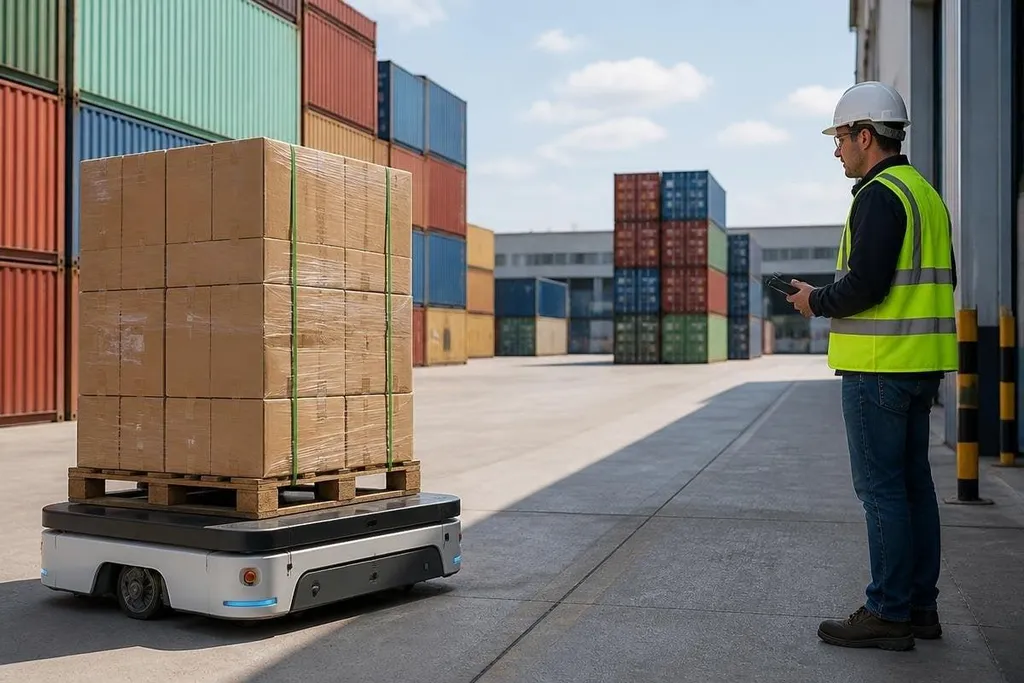
A cargo robot has one job: move a container, pallet, or parcel between two fixed points with fewer handoffs. That could change cargo work by shifting people away from repeated transport and toward loading, checks, repairs, and exception handling.
Quick read
- Autonomous mobile robots can move pallets across marked indoor routes.
- Port robots face salt, rain, uneven ground, and mixed traffic.
- The first useful measure is completed cargo moves, not a video demo.
Where robots fit first
The clearest starting point is a route with fixed stops. An autonomous mobile robot, or AMR, can collect a pallet from a staging lane, read its barcode, and take it to a dock door or storage position.
That route works because the robot can use LiDAR, cameras, floor markers, or a site map to locate itself. A warehouse team also knows where the robot should stop, where people walk, and which areas need a slower speed.
Cargo yards are harder. Outdoor vehicles must handle rain, glare, loose surfaces, parked trailers, and people who do not follow a marked path. A system that works inside a warehouse may need different sensors, tires, software, and safety rules outside.
What changes for the operation
The largest change would come from fewer manual trips between work areas. A robot could wait at a loading point, take a full pallet to a known destination, and return for another task while staff handle goods that need judgment or care.
That does not remove every handoff. Someone still has to place the pallet correctly, confirm the load, clear blocked routes, and deal with a damaged barcode. The robot moves the load; people still manage the exceptions.
A fleet also needs traffic control. Each robot needs a route, a stop rule, a battery plan, and a way to report faults. A blocked aisle can delay several moves if the system cannot send a robot around the obstruction.
The hard parts outside the demo
Cargo sites are full of small changes. A trailer may stop a few meters from its planned position. A pallet may lean into the aisle. A worker may carry a load across the robot's path. These cases test the system more than a clean route does.
Safety needs a physical layer as well as software. Emergency-stop buttons, speed limits, warning lights, safe stopping distance, and clear rules for remote control all matter. A robot that pauses safely is more useful than one that reaches a target quickly and leaves staff unsure what it will do next.
Weather and maintenance add more work. Salt can damage connectors, water can affect sensors, and debris can reduce wheel grip. Operators need inspection points, spare parts, charging space, and a person who can take a failed robot out of service without blocking a lane.
A demo on dry concrete can hide the work a cargo robot faces on a wet, crowded route. Shipping robot reports from Robot24.com can connect each claim to the route, load, weather, stoppages, and test date before the next section lists the measures that matter.
What to measure
A cargo robot should earn its place through site results. Count completed moves, waiting time, blocked-route events, manual interventions, battery stops, and damage reports. A high travel speed means little if the robot spends much of its shift waiting for a clear handoff.
The current process gives you the comparison. Measure pallet travel time, the number of people who touch it, and how often transport delays stop work. Then test the robot on the same route and under the same load rules.
I'd skip a purchase based only on a smooth demonstration. A real trial should include a blocked lane, a misplaced pallet, a low battery, and a safe recovery by staff who did not build the system.
A practical buying check
Use this list before choosing a pilot site:
- Map the route: mark every pickup, drop-off, crossing, door, and charging point.
- Set the load limit: record pallet size, weight, center of mass, and surface type.
- Test the handoff: check how staff confirm a load and what happens after a barcode read fails.
- Plan recovery: name the person who clears a stopped robot and record the expected response time.
- Count the work: compare completed moves, waiting minutes, manual stops, and damage on the same route.
That check points to the next proof point: a shipping robot must complete a live cargo route through ordinary interruptions, with staff able to see, stop, and recover it.
Until operators publish those results, the value of the hardware remains a site question, not a general promise.